How Rivers Write and Rewrite Landscapes
A river may look like a fixed line on a map, but it is better understood as a moving system. Water erodes one bank, deposits sediment on another, abandons old channels, and connects mountains with oceans.
Every bend records a balance among flow, sediment, slope, and resistance.
Erosion on the Outside, Deposition on the Inside
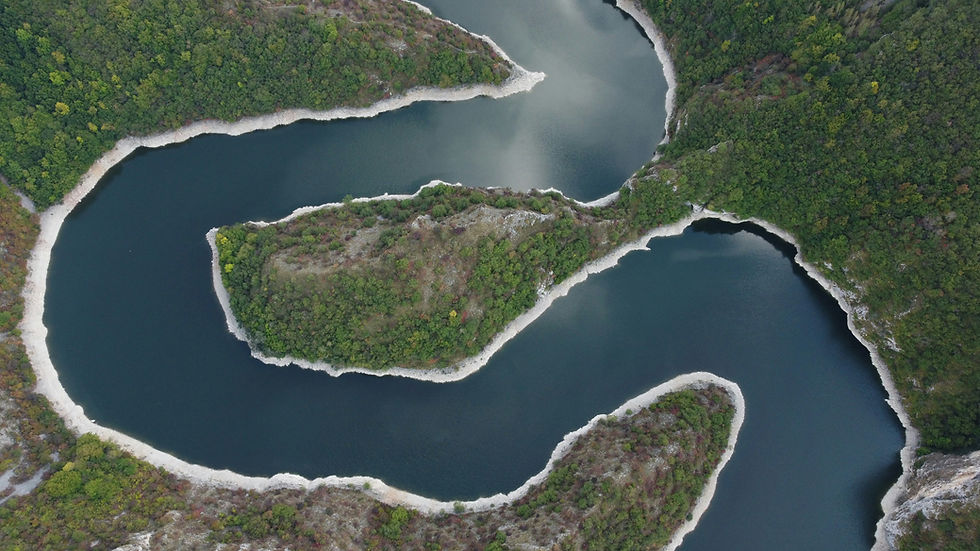
In a meandering river, faster flow often concentrates near the outside of a bend, where it can undercut the bank. Slower water near the inside allows sand and gravel to accumulate as a point bar.
Over time, this paired erosion and deposition moves the channel sideways. If two bends approach each other, a flood may cut through the narrow neck. The abandoned loop can become an oxbow lake.
These changes can happen over years, yet the sedimentary deposits they leave may survive for millions of years.
Sediment Has a History
Grains carried by a river are not identical passengers. Large clasts require stronger flow to move. Fine clay can remain suspended long after sand settles. Grain size, shape, sorting, and composition reveal something about transport distance, energy, and source rock.
When ancient river deposits become rock, cross-bedding and channel-shaped structures allow geologists to reconstruct flow direction and changing environments.
Why Maps Must Include Time
Satellite images make river change easier to measure. By comparing images from different dates, researchers can map bank migration, floodplain growth, and channel abandonment. But a single image can be deceptive: it captures a temporary position, not the river's full behavior.
This is where field observation and data analysis support each other. A time series shows movement; sediment and landforms explain the physical process.
Rivers remind us that landscapes are not static backgrounds. They are active records, continuously edited by water and sediment.


Comments